Choosing the best raised garden bed for vegetables depends on more than size. Material, drainage, root depth, accessibility, and available space all affect how well your plants will grow.
We compared 10 practical options for patios, balconies, backyards, and larger vegetable plots, including modular metal kits, covered beds, elevated planters, and deep-root designs.
Best 10 Raised Garden Bed for Vegetables Picks for 2026
Best Modular Metal Pick
Vego Garden 17-Inch 10-in-1 Raised Bed

- 10 configurable layouts
- 17-inch height with 21 cubic feet
- Rust-resistant coated steel
Best For: Flexible vegetable gardens and easier tending
Best Covered Growing System
Ohuhu 8x4 Raised Bed with Greenhouse Cover

- Detachable greenhouse cover
- Four zippered ventilation doors
- Spacious 8-by-4-foot layout
Best For: Protected vegetable growing in changing weather
Best Long Rectangular Bed
Vego Garden 17-Inch 9-in-1 Planter

- Nine possible configurations
- Long 8-by-2-foot footprint
- 17-inch weather-resistant metal bed
Best For: Row planting along garden edges or paths
Best Elevated Wood Option
Best Choice Products 72-Inch Raised Planter

- Comfortable 30-inch working height
- 8.4 cubic feet of planting space
- Six drainage holes and elevated design
Best For: Patios, decks, balconies, and low-bend gardening
Heavy-Duty Metal Pick
Land Guard Oval Galvanized Bed
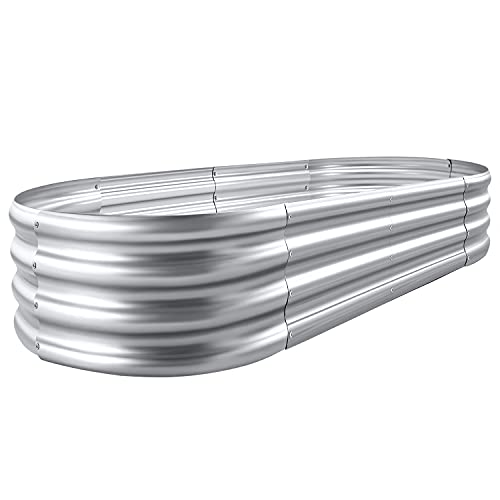
- Thick, double-layer galvanized metal
- Open base promotes drainage
- Compact 4-by-2-foot vegetable-growing area
Best For: Durable, reusable vegetable gardening in compact outdoor spaces
Flexible Wood Garden

- Large 8-by-2-foot planting area
- Removable divider supports flexible layouts
- Open-bottom fir-wood construction
Best For: Organized vegetable, herb, and flower growing in spacious gardens
Two-Bed Value Set
Tegarbed Galvanized Garden Beds

- Includes two 4-by-2-foot beds
- 1mm galvanized steel construction
- Tool-free, bottomless setup
Best For: Separate vegetable and herb planting in compact outdoor gardens
Best Deep-Root Option
6x3x2ft Metal Raised Garden Bed
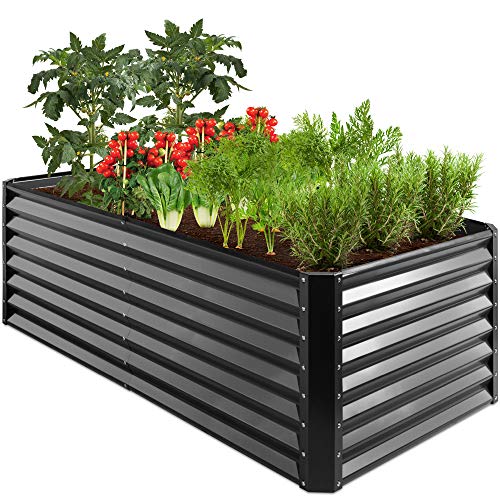
- 24-inch depth for deeper-rooting vegetables
- 269-gallon, 36-cubic-foot planting capacity
- Tool-free assembly with stakes and stabilizing rods
Best For: Medium- to deep-rooting vegetables in spacious yards
Best Elevated Design
48x24x30in Galvanized Raised Garden Bed

- 30-inch height reduces bending and kneeling
- 8-cubic-foot planting space for compact areas
- Integrated drainage and tool-holding corner protectors
Best For: Accessible vegetable gardening on patios and balconies
Best Large-Capacity Pick
8x4x2ft Metal Raised Garden Bed
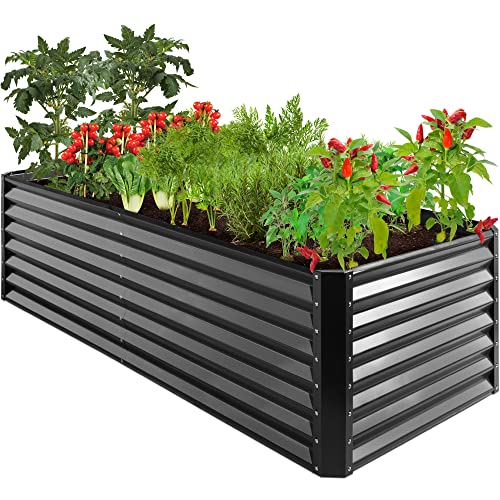
- 24-inch depth for vegetables with deeper roots
- 478-gallon, 64-cubic-foot planting capacity
- Powder-coated steel with three stabilizing rods
Best For: Large vegetable gardens with ample yard space
Best Modular Metal Pick – Vego Garden 17-Inch 10-in-1 Raised Bed
If you want a durable raised garden bed for vegetables that can adapt to changing garden layouts, this Vego Garden kit offers 10 possible configurations. Its 17-inch height provides room for roots while reducing how far you need to bend during planting and harvesting.
Best For: Gardeners who want a customizable, long-lasting metal bed with comfortable working height.
Pros:
- Ten modular configurations help fit different backyard or garden spaces.
- VZ 2.0 coated steel is designed to resist rust and last more than 20 years.
- Oval panels and rubber edge trim help make installation safer.
- Offers 21 cubic feet of growing capacity and 17 inches of depth.
Cons:
- The 41.7-pound kit may require more effort to position before assembly.
- Its metal construction may not suit shoppers seeking a traditional wood look.
This is a strong choice when flexibility, root space, and reduced bending matter more than a fixed rectangular footprint. The modular format also leaves room to expand your gardening setup with compatible accessories.
Best Covered Growing System – Ohuhu 8×4 Raised Bed with Greenhouse Cover
For a raised garden bed for vegetables that also helps shield plants from outdoor threats, the Ohuhu combines a galvanized planter with a detachable greenhouse cover. The 8-by-4-foot bed provides a broad planting area, while four zippered doors support ventilation and access.
Best For: Gardeners who want one setup for raised-bed growing and added protection from frost, insects, birds, and cold weather.
Pros:
- The bed and greenhouse can be used together or separately.
- Eight-by-four-foot dimensions provide a spacious vegetable-growing area.
- Four zippered doors improve ventilation and make plant care easier.
- Galvanized steel and internal support rods help with durability and stability.
Cons:
- The cover skirt needs heavy objects, such as stones, to help keep it secured.
- The one-foot bed height offers less root depth than taller raised beds.
- The large footprint may be difficult to place in a small garden or balcony.
The detachable cover makes this a versatile option for gardeners who want more control over exposure to weather and pests. Its low profile is less ergonomic than a tall bed, but the generous footprint is well suited to larger planting plans.
Best Long Rectangular Bed – Vego Garden 17-Inch 9-in-1 Planter
This Vego Garden kit is a practical raised garden bed for vegetables when you prefer a long, narrow footprint. Its 8-foot-by-2-foot design supports row-style planting, while the 17-inch depth gives roots more room and makes routine garden work easier on your back.
Best For: Growers who want a narrow, modular metal bed for vegetables, flowers, or mixed planting.
Pros:
- Nine configuration options provide layout flexibility.
- The 8-by-2-foot shape fits well along paths, fences, or garden edges.
- Seventeen-inch depth supports root development and improved drainage.
- VZ 2.0 coated steel is weather resistant and designed for a 20-plus-year life.
Cons:
- The long footprint may be less suitable for compact spaces than a smaller modular layout.
- At 33 pounds, the assembled or partially assembled kit may still require careful handling.
Choose this model if you want the working height and durability of Vego’s metal construction in a space-efficient rectangular format. Its nine-in-one design gives you more flexibility than a permanently fixed bed.
Best Elevated Wood Option – Best Choice Products 72-Inch Raised Planter
If you want an elevated raised garden bed for vegetables on a patio, deck, or balcony, this wood planter lifts the growing area 30 inches off the ground. Its six drainage holes help excess water escape, while the elevated design can discourage pets and rodents from reaching plants.
Best For: Gardeners who want a back-friendly wooden planter for outdoor spaces without kneeling or bending to ground level.
Pros:
- Thirty-inch height reduces bending and kneeling during plant care.
- Six drainage holes help aerate roots and release excess water.
- Eight-point-four cubic feet of planting space accommodates vegetables and other plants.
- The elevated structure can help deter pets, rodents, and other animals.
Cons:
- The fixed 72-by-24-inch design offers no modular layout options.
- Its 300-pound capacity limits the combined weight of soil, plants, and water.
- The unfinished wood may require more ongoing care than a coated metal bed.
This is a convenient choice for accessible container-style gardening where an elevated work surface matters most. It trades the deeper root space of tall ground beds for easier reach and added separation from the ground.
Heavy-Duty Metal Pick – Land Guard Oval Galvanized Bed
If you want a durable raised garden bed for vegetables, this Land Guard oval planter combines a compact 4-by-2-foot footprint with a sturdy galvanized-metal build. Its open base supports drainage, while the 12-inch depth suits many common garden crops.
Best For: Gardeners seeking a reusable, corrosion-resistant metal bed for vegetables in a compact outdoor space.
Pros:
- Double-layer galvanized Q195 metal is designed for long-term outdoor use.
- Reinforced oval structure and thick sheet construction help resist deformation.
- Open bottom helps prevent water accumulation and root decay.
- Compact 4-by-2-by-1-foot size provides 7.14 cubic feet of growing space.
Cons:
- The 12-inch depth may not suit deeply rooted crops.
- Metal construction may offer less of a traditional garden look than wood.
This is a practical choice when strength, drainage, and repeated use matter most. Its compact size is easy to place and maintain, while the oval design adds a softer appearance than a standard rectangular bed.
Flexible Wood Garden – Yaheetech Divisible Fir Bed
This Yaheetech wooden raised garden bed for vegetables offers a spacious 8-by-2-foot planting area with two sections for separating crops. The removable divider lets you switch between separate growing zones and one larger bed.
Best For: Gardeners who want a wide wooden planter with flexible organization for vegetables, herbs, and flowers.
Pros:
- Two growing areas make it easier to organize different plants or methods.
- Removable baffle creates one larger planting area when needed.
- Open-bottom design supports outdoor placement and drainage.
- Upgraded corner posts allow more flexible combinations with additional beds.
Cons:
- Unfinished fir wood may require more care than galvanized metal.
- Its 95-inch length needs a relatively large planting area.
Choose this model if you prefer the look of natural wood and need more horizontal growing room. The divided layout is especially useful for separating vegetables, herbs, or flowers without buying multiple smaller planters.
Two-Bed Value Set – Tegarbed Galvanized Garden Beds
This two-pack is a useful raised garden bed for vegetables when you want separate planting zones without taking up excessive space. Each bottomless 4-by-2-by-1-foot oval bed uses 1mm galvanized steel and provides more than 7 cubic feet of growing space.
Best For: Gardeners who want two compact, low-maintenance beds for vegetables, herbs, flowers, or selected root crops.
Pros:
- Two beds allow separate crops or staggered planting.
- 1mm galvanized steel and corrugated panels provide sturdy construction.
- Open bottoms allow natural drainage and access to native soil.
- Tool-free assembly and rolled edges simplify setup and handling.
Cons:
- One-foot depth may be limiting for some deeply rooted vegetables.
- Assembly is estimated at about 20 minutes, longer than some simpler kits.
This set stands out for gardeners who value versatility and multiple planting zones. The compact oval footprint fits smaller outdoor areas, while the galvanized finish is suited to regular outdoor use.
Best Deep-Root Option – 6x3x2ft Metal Raised Garden Bed
If you need a spacious raised garden bed for vegetables with room for deeper roots, this 6-by-3-foot steel planter provides a 24-inch growing depth and up to 269 gallons of soil capacity. Its open-bottom design suits gardeners who want to place the bed directly on the ground.
Best For: Medium- to deep-rooting vegetables such as broccoli and beans, along with herbs and flowers.
Pros:
- 24-inch growing depth supports medium- to deep-rooting plants.
- Powder-coated steel panels, ground stakes, and stabilizing rods provide a sturdy setup.
- Tool-free assembly uses included wingnuts and bolts, with rubber edging for added safety.
- Materials are tested for FHSA standards and are free from heavy metals and phthalates.
Cons:
- Bottom panel is not included.
- The large 72-by-36-inch footprint requires considerable outdoor space.
Choose this model when root depth matters more than portability or elevated access. The 36-cubic-foot planting area is generous, but you will need to supply and prepare the soil yourself.
Best Elevated Design – 48x24x30in Galvanized Raised Garden Bed
This elevated model is a practical raised garden bed for vegetables when standing-height access is more important than maximum soil depth. Its 30-inch height helps reduce bending and kneeling, while the 8-cubic-foot planting space fits vegetables, herbs, and flowers in patios, porches, balconies, and other compact outdoor areas.
Best For: Gardeners seeking a more accessible planter for small outdoor living spaces.
Pros:
- 30-inch standing height helps reduce bending and kneeling.
- Integrated drainage supports healthy plant growth.
- Galvanized metal construction is designed for weatherproof outdoor use.
- Corner protectors help prevent injury and can hold gardening tools.
Cons:
- Its 8-cubic-foot capacity is smaller than the larger in-ground-style beds in this roundup.
- The elevated design may be less suitable for plants requiring very deep root space.
For accessible gardening on a patio or balcony, this compact elevated bed offers a convenient working height and useful drainage features. Its 48-by-24-inch footprint is easier to fit into limited spaces than a full-size garden bed.
Best Large-Capacity Pick – 8x4x2ft Metal Raised Garden Bed
For gardeners planning a substantial harvest, this 8-by-4-foot raised garden bed for vegetables offers a 24-inch growing depth and 478-gallon capacity. The 64-cubic-foot planting area gives vegetables, herbs, and flowers plenty of room, although its broad footprint is best suited to a spacious yard.
Best For: Large vegetable gardens and deep-rooting crops such as broccoli, beans, cucumbers, romaine lettuce, and strawberries.
Pros:
- 24-inch depth accommodates medium- to deep-rooting plants.
- Large 64-cubic-foot planting area holds up to 478 gallons of soil.
- Powder-coated steel panels and three stabilizing rods support a durable structure.
- Tool-free assembly includes beveled panels, wingnuts, bolts, and rubber edging.
Cons:
- Bottom panel is not included.
- The 96-by-48-inch size needs substantial outdoor space and soil.
This is the strongest choice of the three for maximizing planting area and separating a broad selection of seasonal crops. Make sure your site can accommodate its large footprint and that you are prepared to fill its considerable capacity.
How We Picked the Best Raised Garden Bed for Vegetables
We focused on the features that matter most for productive, manageable vegetable growing: usable planting area, soil depth, material durability, drainage, assembly, access height, and overall versatility. The selection includes compact beds for patios and balconies, larger models for substantial harvests, and modular designs that can adapt to different layouts.
Because growing conditions vary, there is no single best design for every gardener. Galvanized metal generally offers long-term weather resistance, while wood can provide a more traditional appearance. Elevated beds may reduce bending, but they usually hold less soil than ground-level models.
Quick Comparison
| Best for | Recommended style | What to prioritize |
|---|---|---|
| Small patios and balconies | Compact elevated bed | Footprint, weight, drainage, and safe placement |
| Mixed vegetables and herbs | Medium metal or wood bed | Accessible width and at least 12 inches of soil depth |
| Deep-rooted crops | Deep metal planter | 18 to 24 inches of growing depth |
| Large backyard gardens | Long or modular bed | Capacity, layout flexibility, and sturdy construction |
| Seedlings and pest protection | Covered raised bed | Cover quality, ventilation, and convenient access |
Key Buying Factors for a Raised Garden Bed for Vegetables
Size and Planting Access
Choose a width that lets you reach the center without stepping into the bed. Around 2 to 4 feet wide is typically manageable from one or both sides. Measure pathways as well as the bed itself, and leave room to water, harvest, and move around it.
Depth and Soil Volume
Leafy greens and many herbs can grow in shallower beds, but tomatoes, carrots, peppers, and other larger crops benefit from more root space. Deeper beds also require more soil, so account for both filling cost and weight.
Material and Drainage
Galvanized metal is a durable choice for outdoor use and is available in many modular shapes. Wood blends naturally into garden settings but may eventually weather or require maintenance. Bottomless beds rely on the ground for drainage, while elevated models need drainage holes that do not clog.
Assembly and Stability
Check whether the kit includes connectors, hardware, a liner, or a cover. Large beds filled with wet soil become very heavy, so place them on a level surface and confirm that legs, seams, and sidewalls are adequately supported.
Who Should Buy Which Raised Garden Bed for Vegetables?
Apartment and balcony gardeners should favor compact elevated planters with manageable soil capacity. Gardeners growing root vegetables or larger crops should choose a deep-root design. If you want to expand gradually, a modular V-shaped or multi-configuration kit offers more layout flexibility. For a traditional backyard setup, a long galvanized or wooden bed provides a useful balance of capacity and accessibility. Choose a covered model if young plants need protection from pests or changing weather.